
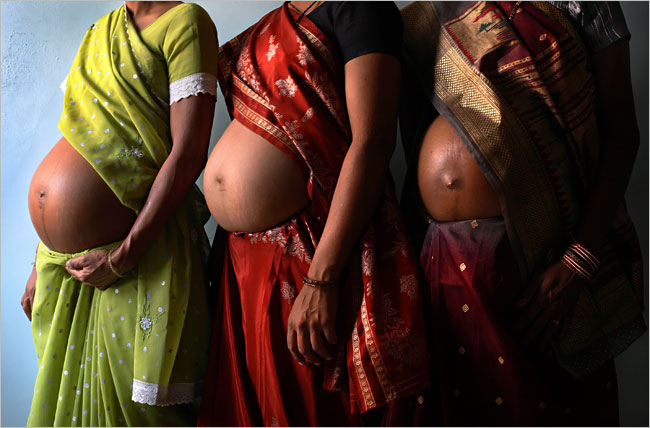
Photo Le Monde2 du 19 juin 2009 (S. Clair)
La loi sur la bioéthique, l’éthique de la vie dont on peut mieux comprendre toute l’actualité en lisant ceci, aura à prendre position sur la question de la gestation pour autrui, débat plus connu sous l’item des mères porteuses.
C’est une question complexe que les législateurs auront à trancher. Aujourd’hui cette possibilité est interdite en France. « Le fait de s’entremettre » pour recourir à cette pratique est passible d’un an d’emprisonnement et de 15.000 euros d’amende. Cette amende est doublée si cet acte est réalisé pour des raisons lucratives. L’interdiction française a été votée en 1994 puis une nouvelle fois en 2004. Pour autant il y a déjà eu des cas de mères porteuses en France, autorisée par la loi puisque n’y dérogeant pas, n’y dérogeant pas parce que la loi n’existait pas. C’était entre 1987 et 1991. On estime à 70 le nombre d’enfants nés de mères porteuses durant cette période. A ma connaissance, il n’existe pas d’études épidémiologiques sur le suivi de ces enfants depuis, ce qui aurait pu permettre aux législateurs de trancher en toute connaissance de cause et d’éviter les fantasmes de part et d’autre. (Maj 24/06/2009 : L’Express revient dans son édition du jeudi 25 juin sur cette question via un article reprenant le parcours de trois familles avec les témoignages de leurs enfants nés de mère porteuses).
Nombreuses sont aujourd’hui les personnes et organisations à prendre position sur cette question.
Parmi les tenants d’une autorisation contrôlée du recours aux mères porteuses, on trouve : l’association Maia, le Comité Clara, Elisabeth Badinter, la ministre de la famille, Nadine Morano, Geneviève Delaisi de Perceval, un groupe de travail du Sénat.
Parmi les opposants, aux rangs plus fournis, on trouve, le « père » du premier bébé éprouvette français, le médecin René Frydman, la philosophe Sylviane Agacinski, la ministre du logement, Christine Boutin, l’OPESCT (l’office parlementaire dédié à l’éthique qui regroupe plusieurs députés et sénateurs sensibles à ces questions et qui publient des rapports), le Comité Consultatif National d’Ethique, les églises catholiques et protestantes ainsi que les représentants de l’islam et dans une moindre mesure le consistoire de Paris. A propos des opposants, René Frydman se dit « outré par le lobbying de certaines associations qui prônent la légalisation de cette pratique pour défendre les intérêts de quelques nantis ». C’est cinglant, fort, trop peut-être.
Chaque camp y va de son influence pour faire progresser ses idées. Des interviews sont données, des blogs ouverts, des participations à des conférences ou colloques entreprises, des courriers et dossiers expédiés auprès des parlementaires, des réflexions engagées afin de faire progresser ses idées, défendre son point de vue, (comme la synthèse du Conseil d’Etat le montre) augmenter sa visibilité et participer à la construction de la décision sur ce sujet complexe.
Arguments pour.
- Accepter un acte de générosité. « Donner » son corps le temps d’une grossesse pour qu’un couple puisse accueillir son propre enfant est un acte altruiste de haut niveau. C’était la motivation essentielle des mères porteuses françaises à la fin des années 80. Cet acte est parfois proposé par des proches de la femme qui ne peut porter son enfant : la mère, la sœur, une amie…[dailymotion]http://www.dailymotion.com/video/x6hb3u_meres-porteuses-faire-un-bebe-pour_news[/dailymotion]
- Eviter le tourisme procréatif. Plusieurs pays dans le monde acceptent le recours aux mères porteuses. Il s’agit notamment des Etats-Unis, du Canada, de la Belgique, de la Grande-Bretagne, des Pays-Bas, de l’Ukraine, du Danemark et de la Grèce, soit cinq pays de l’Union européenne. D’autres pays, comme l’Inde, accepte cette pratique et procède à une industrialisation du procédé comme il sera objecté par les opposants à cette légalisation. Accepter le recours aux mères porteuses permettrait donc d’éviter deux poids-deux mesures entre ceux qui disposant des moyens financiers et culturels d’établir des contacts avec l’étranger en ce sens, et ceux qui, pour diverses raisons, ne le peuvent pas. Selon cet argument, c’est le maintien du principe d’égalité qui prévaut.
- Eviter les problèmes d’Etat civil. Comme le suggère l’affaire Mennesson, recourir aux mères porteuses à l’étranger n’est pas sans poser problème lors du retour en France des parents biologiques avec leur enfant. Qui est cet enfant ? L’enfant de sa mère selon la législation française ? Qui est sa mère selon la loi ? Celle qui accouche l’enfant. CQFD. Or, l’intérêt de l’enfant, ici celui d’avoir une identité légale, un état-civil, sans lequel aucun acte de la vie courante ne peut être réalisé (avoir un passeport, voter, passer un examen…), est primordial, selon notre culture, sur l’ensemble des autres principes pouvant être mis en avant.
- Ne pas refuser le progrès des technologies médicales. Alors que le don de gamètes, mâles et femelles, spermatozoïdes et ovules, est permis, que le don d’embryon est accepté, pourquoi est-ce que le prêt de son corps serait-il interdit à une personne consentante ? En vertu de quels principes éthiques ou moraux ? Ne serait-ce pas nier l’intérêt du progrès de la science dans le domaine médical que de refuser ce progrès qui nous tend les bras ?
- Aider à combattre la souffrance des femmes qui ne peuvent avoir d’enfants. Au-delà de la question de la convenance qui pourrait motiver des femmes à ne pas accoucher (peur de l’accouchement, peur de la décrépitude du corps par la suite, anxiété par rapport à la souffrance…), il existe un certain nombre de raisons purement médicales qui empêchent des femmes de pouvoir porter leurs enfants. C’est le cas des femmes dont l’utérus a été altéré par une radiothérapie par exemple, des femmes touchées par le syndrome de Mayer-Rokitansky-Küster-Hauser. Au total, on estime, selon la Croix, à 300 le nombre de femmes concernées par le syndrome de Mayer et l’hémorragie de la délivrance. Or dans la société qui est la nôtre, il existe une forte pression sociale (sans parler des pressions biologiques et psychologiques) à ce que les femmes en âge de procréer le fassent. Cela explique en partie les niveaux de fécondité dans notre pays, et cela renforce la souffrance de celles qui ne peuvent assumer le rôle social qui leur est conféré.
- Un mouvement se dessine dans l’opinion. Non pas que les français, selon les enquêtes d’opinion, soient devenus majoritairement pour cette évolution, mais 1/3 d’entre eux n’y sont pas opposés. Or on le sait les lois qui entraînent de profonds changements ne peuvent se faire sans l’assentiment d’une part importante de la population. Pour deux raisons au moins, primo, parce qu’elle permet aux partisans de cette évolution de disposer de soutiens et de relais dans l’opinion publique, secundo, parce qu’elle coupe du coup l’herbe sous les pieds des opposants, plus de soutiens dans l’opinion, c’est moins d’opposants dans la rue, sur les forums internet, dans les colonnes des journaux. Aujourd’hui, néanmoins, du point de vue de l’opinion publique, la partie n’est pas gagnée pour les partisans d’une légalisation. Ces derniers ont toutefois réussi leur premier pari : celui de mettre sur la place publique la question. Elle n’est plus taboue. C’est une première étape, indispensable, dans la reconnaissance de la gestation pour autrui.
- Cela s’est déjà fait, cela se fait. L’argument qui vise à démontrer que ces pratiques sont anciennes et encore actuelles, malgré l’interdiction, sont quelque peu spécieuses du point de vue de la morale du débat public, mais constitue un fait. En France, comme je le rappelais en introduction, cela a été une réalité tolérée pendant quatre ans. Et aujourd’hui encore, sans que l’on sache combien de personnes sont concernées, cette pratique à cours. Si ce n’est dans des centres sur le territoire national au moins par des citoyens se rendant à l’étranger.
- Et le père dans tout cela ? On considère souvent que la question des mères-porteuses touche surtout les femmes. Il est vrai qu’il n’existe pas de père-porteur et pour cause. Cependant, « les femmes ne peuvent pas faire des enfants toutes seules ». A un moment donné au moins, un peu avant la fécondation, l’homme est nécessaire. Par sa présence, et son éjaculation, ou par contumace, en ayant congelé son propre sperme ou en donnant son sperme dans un Cecos. Or dans le cas d’un couple de parents potentiels, un homme et une femme donc au sens de la loi, si l’on a vu la puissance du souhait, désir ou besoin, féminin, la place du père, de son souhait, de son désir ou besoin, est négligée. Il dispose lui aussi du droit à avoir des enfants, si tant qu’il existe. Et dans une société libre, il peut décider avec qui il souhaite les avoir. Si cette femme qu’il veut pour mère de ses enfants ne peut accueillir la gestation de leur enfant, ne subit-il pas là une double-peine. Celui de voir souffrir sa femme et celui de ne pas pouvoir être père.
Arguments contre.
- Il n’existe pas de GPA sans commerce. C’est un argument massue. Dans de très nombreux cas, la gestation pour autrui est instrumentalisé pour devenir un business. En Inde, des femmes, recluses dans un centre d’hébergement, sont recrutées pour devenir mères-porteuses pour le compte de richissimes étrangers ou nationaux qui « achètent » cette possibilité pour un peu moins de 10.000 euros. En Ukraine, il faut compter 15.000 euros. En Amérique du nord, environ 40.000 euros. Selon la nature des contrats, des responsabilités juridiques, des assurances, le prix varie. La terre est plate, écrivait le journaliste américain Thomas Friedmann. Rien n’est plus vrai en ce qui concerne les mères porteuses. Il est possible de choisir sa zone de production et les garanties qui vont avec. L’argument porte sans conteste mais il reste théorique. Personne ne peut affirmer avec exactitude qu’en France cela se passerait de la même manière puisque la pratique est interdite. Tout laisse à croire que cette question est un frein considérable à une acceptation par l’opinion publique : un enfant ne peut pas avoir de prix, même si ici on ne parle pas d’achat d’enfants mais de prêt ou de location de ventres puis d’expulsion du locataire.
- Cela n’est pas « une priorité de santé publique ». Dans une interview sur cette question donnée à l’hebdomadaire l’Express, le gynécologue René Frydman, indique que déjà les demandes de procréation médicalement assistée, auxquelles il est favorable, Fécondation in vitro, insémination artificielle… sont difficiles à satisfaire. Pour des raisons de moyens dans les rares centres médicaux proposant ces services ou bien raison d’un fort manque de donneurs de gamètes. Ainsi, l’agence de Biomédecine indique dans son rapport annuel que 400 couples par an sont en attente de dons d’ovule mais que seulement 220 femmes sont volontaires chaque année pour suivre le traitement médical inhérent à ce don et au final à donner plusieurs de leurs ovules.
- Le corps médical n’accepte pas cette technique. Dans leur immense majorité, les médecins sont peu enclins à accepter l’évolution de la législation sur les mères porteuses. Jean-François Mattéi, médecin, ancien ministre de la santé, auteur d’un ouvrage remarquable sur la bioéthique, s’affirme contre pour les raisons exposées ici. Or, et même si au moment du débat l’autorisation de l’Interruption Volontaire de Grossesse en France, au début des années 70’s, ils étaient plus de 10.000 à contre-signer un appel anti-IVG, il est difficile de changer les lois de bioéthique sans leur consultation voire leur assentiment. Le groupe de pression qu’il constitue, même si son front n’est pas toujours uni, représente un fort pouvoir d’influence d’autant plus que nombre de parlementaires sont issus de leurs rangs et donc sensibles au moins par atavisme à leurs arguments.
- Le statut de la mère-porteuse est flou d’un point de vue juridique. Qui est la femme qui accouche pour cet enfant qui n’est pas biologiquement le sien ? Qui est cet enfant pour cette femme qui accouche ? On ne mesure pas bien les effets psychologiques pour la femme qui accouche de laisser son enfant à sa mère-biologique. Le groupe de travail du sénat qui s’est penché sur la question propose que la mère-porteuse puisse changer d’avis dans les trois jours qui suivent l’accouchement. C’est-à-dire, qu’elle puisse décider de garder cet enfant qui n’est pas tout à fait, loin s’en faut, le sien. Habituellement, dans le cas classique, durant les trois jours qui suivent la naissance d’un enfant, toute la famille, tantes, oncles, frères, sœurs, pères, mères, amis sont venus à la maternité ou à l’hôpital, ou dans la cuisine, ou dans la piscine, voir l’enfant, féliciter la mère, le père de l’enfant, évoquer sa ressemblance avec untel ou untel, donner des cadeaux, le prendre dans ses bras. A sa naissance l’enfant a déjà neuf mois. On lui donne, on lui a donné un prénom, une identité. Il est accueilli dans sa famille à bras ouverts. Il est l’avenir. Il est l’espoir. Comment dès lors accepter que pendant trois jours, trois longs jours, un couple soit dans l’attente fébrile d’un changement d’avis de la parturiente ? Quelle angoisse ! Quelle souffrance de l’attente ! Enfin, quid du droit de visite opposable que pourrait demander la mère porteuse ? Elle l’a tout de même porté cet enfant, nourri, parlé, susurré peut-être même des mots d’amour. Et si tel n’est pas le cas, alors que des études ont prouvé toute l’importance de la quiétude de la mère pendant la période de la grossesse et de la présence du père, pourquoi cet enfant se verrait-il priver, dès le départ, au-delà de la vicissitude des vies de couple, de ces attentions.
- Cela suppose un contrat qui n’est pas admissible. Recourir à une mère porteuse suppose une contractualisation entre les deux parties, la porteuse et les receveurs, avec des engagements de part et d’autre, des droits, des devoirs. D’un point de vue philosophique, cette assujétion, cette aliénation de l’homme par l’homme n’est pas recevable. Cela se passe déjà dans les contrats de travail, mais pas avec ces implications, cette constance durant tout le temps de la grossesse. Ce contrat entraîne également des responsabilités juridiques. Que se passe-t-il si cette mère porteuse préfère la foire au repos, l’alcool aux fraises, la cigarette roulée à la cigarette russe ? La sélection des mères-porteuses en amont devrait pouvoir garantir en partie le sérieux des candidates mais sans pouvoir assurer à plein la loyauté de la mère-porteuse vis-à-vis de ses engagements.
- Et si les parents biologiques refusent l’enfant ? Cette question est rarement posée. On peut supposer qu’un couple qui s’engage dans cette démarche sait pourquoi il l’entreprend, a mûri sa réflexion, a tout essayé en dehors de ce procédé. Mais quid si pendant le temps de la grossesse les parents se séparent ? Est-ce la loi commune sur l’autorité parentale qui s’applique ? Comment le décider ?
La question de l’ouverture du recours aux mères porteuses aux couples homosexuels ne se pose pas ici. Car l’on suppose que c’est l’enfant biologique, issu des gamètes d’un couple, donc différenciées, homme-femme, qui serait porté par la mère-porteuse.
On le voit à la lecture de ces arguments rassemblés que cette question reste complexe par ses conséquences possibles. Elle nous confronte aussi à nos a priori. Comme le dit Sylviane Agacinski, « Dans ce domaine, la France n’est pas en retard, elle est en avance ». Chacun se fera son opinion, Sylviane Agacinski est clairement contre, mais en tout état de cause, notre pays est sans conteste en avance sur la question du débat public autour de cette thématique.
Sylviane Agacinski et François Olivennes débattent de cette épineuse question.
La gestation pour autrui (où la femme qui porte l’enfant n’a aucun lien génétique avec l’embryon porté) souvent amalgamée avec la procréation pour autrui (où la femme porte un enfant issu de ses propres gènes) a commencé en 1984 en Californie. Suite à la crainte de conflits autour de la garde et de la filiation des enfants nés par ce recours, mais également pour répondre à un risque de marchandisation du corps de la femme, des commissions ont étudié des lois pour encadrer les pratiques dont la première a été votée en 1985 en Angleterre.
Ont suivi l’Australie, Israël, la Nouvelle Zélande et des états américains (la plupart du temps par jurisprudence). A la suite de la mise en place de ces dispositifs légaux, les conflits suscités par des phénomènes que l’on pourrait qualifier de « panique morale » ont disparu. Et depuis la pratique de la GPA se développe de manière continue dans des conditions qui ne sont plus contestées, aucune autorité n’étant par ailleurs revenu sur la légalisation.
Il est regrettable que l’efficacité de ces dispositifs légaux n’ait pas été évaluée par les institutions françaises qui se sont exprimées sur la GPA, voire agitent comme des contre-exemples ou des « moins-disant éthique » des rares pays comme la Belgique et l’Inde, où il n’existe pas d’encadrement légal.
L’intérêt de l’enfant et la notion de parenté :
L’intérêt d’un enfant qui n’est pas encore né est une notion très abstraite qui renvoie à la perception même de la parenté, et qui au final est utilisée comme un « droit » de l’enfant à ne pas naître, sorte d’eugénisme passif envers les couples qui ne peuvent porter d’enfant. L’histoire même de l’humanité devrait nous empêcher de limiter la parenté à un seul des éléments biologiques, la gestation, au détriment de la transmission d’un patrimoine génétique et surtout, du fait social : est mère ou père celle ou celui qui se comporte comme tel au regard de la définition qu’en donne la société.
Il ne s’agit pas de nier l’importance des échanges in utero entre la femme enceinte et le foetus, mais de considérer l’immense variété de vécu des grossesses et l’absence de déterminisme utérin. L’affirmation que la GPA serait synonyme d’abandon relève de cette approche réductrice de la parenté. Si on suivait cette définition de l’abandon, il faudrait revenir sur la légalisation en France du don d’embryons pour être cohérent. Mais il n’en est rien, car un enfant qui est désiré et attendu de manière continue par un couple ne peut être considéré comme abandonné. L’attachement n’est pas une fonction biologique mais une construction psychologique.
La revendication du primat biologique gestationnel est souvent l’expression d’une défiance, d’un refus de l’intrusion de la médecine pensée comme une forme de mécanisation de la reproduction. Au contraire de l’image d’Epinal d’un accouchement sous la seule protection de Dame Nature, nous devons nous rappeler qu’en un demi-siècle, les progrès de la médecine reproductive, dont les représentations fantasmées sont l’éprouvette et la couveuse, a permis de mettre fin dans nos pays riches au fléau de la mortalité infantile et à celui des femmes mortes en couches.
Les couples infertiles ne revendiquent jamais de « droit à l’enfant » mais le « droit des enfants », et notamment celui de ne pas être privé de l’histoire de sa venue au monde, au moment où chacun s’accorde à dire, à commencer par les parents adoptifs qu’il faut supprimer les secrets liés à la naissance.
Exploitation ou autonomie de la femme ?
La femme porteuse de l’enfant d’autrui serait donc utilisée comme une machine, « dénuée de toute humanité » ? Notons que l’utilisation d’un vocabulaire dégradant et réducteur tel que « ventres à louer » relève presque exclusivement de ceux qui prétendent respecter la dignité de la femme. Cette volonté de caricaturer nie l’autonomie de la femme et dénigre le principe même du don.
La dignité de la femme ne serait-elle pas mieux respectée si l’on comprenait que dans la gestation pour autrui, elle s’efforce d’agir de façon aussi juste et raisonnée que possible, en respectant autrui ? L’enjeu fondamental pour la société – mais aussi pour ces femmes – est de s’assurer qu’elles sont correctement informées de la démarche envisagée, et que leurs attentes ne sont pas en décalage avec celles des parents intentionnels. Pour arriver à cette logique d’échange et de respect mutuel, il faut admettre que pour certaines femmes, la grossesse est une période de vie épanouissante.
Les couples infertiles souhaitent qu’un véritable débat ait lieu sur la question d’un cadre législatif altruiste qui mette fin à la prohibition de la gestation pour autrui en France. Notre pays ne peut plus se cacher derrière des caricatures moralisantes alors que la GPA existe déjà sur le sol national de façon clandestine, avec tous les risques qu’une absence d’encadrement implique.
Nous ne pouvons pas continuer en France à faire comme si rien n’avait changé depuis les débats d’avant 1994, comme si l’on n’avait toujours aucun recul et comme si les bonnes pratiques n’existaient pas. La France, pays des droits de l’Homme, ne peut pas davantage continuer à nier l’existence et les droits des enfants nés par GPA à l’étranger.
C’est très amusant de relire cet article à la lueur de la proposition de loi de légalisation de la gestation pour autrui déposée le 27 janvier 2010 par 70 sénateurs. On se rend compte que la quasi totalité des arguments avancés contre la GPA sont faux.
Ainsi, comme le trouve cette proposition de loi,on peut faire de la GPA sans commerce, sans régime contractuel, en donnant un statut très clair à la gestatrice, en établissant une filiation qui protège l’enfant d’un (improbable) désistement des parents…
Il reste donc seulement l’argument que le corps médical n’accepterait pas cette technique. Ce qui est faux ! Il suffit de lire l’enquête « Résultats au questionnaire Assistance Médicale à la Procréation (GEFF, BLEFCO et le CNGOF, la SFG et la FNCGM, 2 octobre 2008 » pour connaître la réalité.
Cela se passe de commentaire.
Il y a peu, sur un forum, j’ai lu ces propos:
« Personnellement, je suis contre la GPA.
Vouloir avoir un enfant à tout prix ( a n’importe quel prix…faire commerce de la conception d’enfant berk) alors que tellement d’enfants souffrent et attendent d’être adoptés. Je n’ose pas aborder la psyché que l’enfant peut développer d’avoir été conçu comme ça et le traumatisme pour la mère porteuse. C’est vraiment une mentalité de riche et d’égoïste. En Somalie les femmes en sont à essayer de sauver les enfants de la famine, alors la location de ventre…Faudrait plutôt accueillir ces enfants et les faire adopter momentanément histoire de les sauver. C’est dans ce sens que j’ai écrit que la GPA c’est un truc de riche égoïste. »
Et hop, 4 lignes d’idée reçues sur la GPA mais aussi sur l’adoption.
Sinon,je suis agacée par le fait que l’on mélange deux termes différents pour moi: « Mère porteuse » et « Gestatrice ».
Dans la plupart des documents, l’utilisation du mot « mère porteuse » masque les profondes différences qu’il y a entre procréation pour autrui (la femme qui porte l’enfant fournit également son ovule) et gestation pour autrui dit GPA (la femme qui porte l’enfant n’a pas de lien génétique avec l’enfant). En effet, les dernières études font état de nombreux échanges moléculaires entre la mère et l’enfant. Ces échanges sont régulés par l’ADN dit mitochondrial. Au contraire de l’ADN nucléaire qui se transmet par une combinaison de l’ADN nucléaire des parents, l’ADN mitochondrial ne se transmet que par la femme. Ainsi, en cas de procréation pour autrui, la femme qui porte l’enfant transmet son patrimoine génétique à l’enfant, et les échanges intra-utérins sont régis par son propre ADN mitochondrial. La contribution de la femme infertile est dans ce cas purement sociale comme dans l’adoption. Mais, en cas de gestation pour autrui, la femme qui porte l’enfant ne transmet pas de patrimoine génétique à l’enfant, et les échanges intra-utérins sont régis par l’ADN mitochondrial de la femme infertile qui a fourni ses propres ovules. Ainsi, la contribution de la femme infertile est présente dans ce cas non seulement en termes de reconnaissance physique avec l’enfant, mais elle participe même à la vie utérine au travers de son ADN mitochondrial. Pour simplifier, il y a deux femmes qui participent à la grossesse.
Ces précisions biologiques me semblent très importantes. Avec cet éclairage, je pense qu’il est préférable :
– de maintenir la prohibition de la procréation pour autrui du fait des liens de ressemblance et de développement entre la femme et l’enfant qu’elle porte.
– de légaliser la gestation pour autrui qui permet d’avoir une continuité biologique entre l’enfant et le couple infertile, et ce même pendant la grossesse. Et qui de plus minimise les risques de souffrance de la femme en remettent l’enfant à ses parents car cet enfant ne lui ressemblera pas.